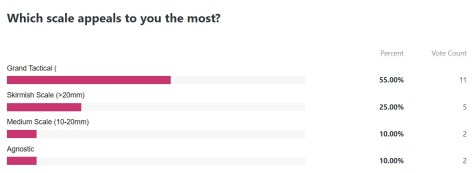
So the results of last weeks votes are as follows:
So this gives us some extra direction when it comes to writing the rules, as we know that each element will represent a Battalion strength unit and that the game will be played on a four foot square area. Excellent! If we factor in that we also want the game to last no more than two hours and that all the measurements will be carried out in inches, we only have perhaps two more votes to go before we get into the nitty gritty of the rules themselves.
Base Shape
This may not seem important to some people, but the base shape can define a lot of things in regards to measuring distances as well as movement. For example a rectangular base would mean that you have to take into account that the base is wider than it is deep and so wheeling and turning become a factor in movement. A round base negates that factor as everything can be measured from the base edge without too much concern, though if you want flanking inside the game having round bases makes this difficult. Alternatively, there’s the option to have a square base, which makes turning and wheeling less of an issue, and can include flanks for the various edges IF we want that as a factor in our game.
Base Size
Our playing area is going to be 4 foot square and so this will have a slight impact on base sizing. We can’t have large bases because of fitting enough of them inside the game. But we can’t have too small either as we want enough models on the base to make it look the part.
There we have it! Next week we will start looking at factions and whether we should include the ability to construct our own or write rules for pre-made factions (or both).
I’ve done a number of top 3’s now for Age of Sigmar, so today I thought I would branch out and cover a top three for 40k. This time we’re back in Europe and looking at the West Coast GT held in Bohus, Sweden.
Tom Ogden – Black Templars
Tom won the event with 5 wins from 5 and 491 battle points.
HQ ———- Chaplain Grimaldus (140 pts)+ – Litanies: Litany of Divine Protection, Fires of Devotion & Litanies of Hate High Marshal Helbrecht (160 pts)+ Primaris Chaplain (85 pts)++ – Litanies: Litany of Hate – Canticle of Hate – The Crusader’s Helm
Fast Attack ———- 5x Inceptor Squad (375 pts)+ – x2 Plasma Exterminator – The Crux Obsidian – Inceptor Sergeant: Champion of the Feast 3x Attack Bike Squad (180 pts)++ – 3x Multi-Melta
Heavy Support ———- 6x Eradictor Squad (270 pts)++ – 5x Eradicator: 5x Bolt Pistol – Eradicator Srgt
Detachments ———- +Patrol: Black Templars ++Patrol: Black Templars
Total Points: 1999 pts
John DeFrank – Orks
John managed 4 wins from 5 and 473 battle points.
No Force Org Slot ———- Nob on Smasha Squig (65 pts)+ – Proper Killy – Stratagem: Big Boss Nob on Smasha Squig (65 pts)+ – Headwoppa’s Killchoppa – Stratagem: Extra Gubbinz
HQ ———- Beastboss on Squigosaur (Warlord) (145 pts)+ – Big Killa Boss – Beasthide Mantle Warboss (105 pts)++ – Brutal but Kunnin – Attack Squig – Da Killa Klaw – Kombi-Scorcha, Power Klaw – Stratagem: Big Boss – Stratagem: Extra Gibbinz
Our latest votes are in and you’ve all voted that games should take up to two hours and that measurements should be carried out in inches.
Now we can start getting into some more detail of the game, such as the gaming area and the smallest element of the game.
Gaming Area Size
There are a few things we need to take into account here. The first is that we wold like the game to take up to two hours. Therefore, we have to consider this when we think about our gaming area, a smaller gaming area may result in either more detailed rules or a ruleset where it becomes difficult to kill units, this is because with a smaller gaming area there will be less units on the board and therefore you want those units to be in play for a longer period of time in order to have the opportunity to survive till the games end.
Likewise, if the table is too large then there will be many more units on the table and the rules will have to be adjusted to make them either easy to kill or make it so that there movement or range becomes a lot further than you would expect in order to make it across the gaming area.
I’ve therefore narrowed these options slightly to ensure that the rulesets don’t become too influenced by these affects.
Smallest Element
Our next question is about the smallest element in the game, what should this represent. I’m using this to classify air and ground units only, as with the space combat element, we’re going to assume the elements are the individual ships themselves.
There are a number of options to go with here and these will have an affect on the way in which the overall ruleset is contructed. For example, should we go with a single base representing a squad of men, or should it represent an entire Regiment? Should it be an individual tank or should it be a squadron of tanks? If we choose a base representing a squad or a single tank then we have to write the rules to represent this, likewise if the elements represent a platoon, battalion or even a brigade. So the question here is what level do you want individual battles to take place at?
All the options below are based roughly off the modern military formations of the British Army;
I’ve added a page to the website called Wargame Rules. In there you will find any rules for scenarios or wargames that I write. At the moment its pretty empty apart from one item which is Clausewitz.
Clausewitz is the Napoleonic wargame I’ve been working on for a number of years now. This is still very much a work in progress but I’m pleased to say it’s at a stage now where I feel comfortable releasing it for public consumption.
What is Clausewitz?
Clausewitz is a Corp level game designed primarily for 6mm Napoleonic warfare. I always wanted a Napoleonic game which focused on the whole battle but where what the individual battalions actions were still important to the outcome. Therefore in Clausewitz although the basic unit is the Brigade, those brigades are made up of individual elements called Battalions or Squadrons. Think of this like individual models inside a squad in a game like 40k or AoS.
The key features of Clausewitz include:
A departure from the traditional IgoUgo turn sequence and instead relies upon chips drawn from a bag to represent a Generals actions in the turn (with each turn representing 10 minutes of battle).
The game is driven by your Generals, they must position themselves and activate the right units at the right time in order to win the day.
Objectives – There are six objectives and units can only claim an objective (and therefore score points) if a General has ordered them to do so.
Mini-Game – there is an optional fun mini pre-game to the main event in which your light troops determine the deployment zone in the upcoming battle.
Formations matter! Brigade formations and individual unit formations are presented in an intuitive fashion. The players must ensure that their units are in the right formations for the task at hand!
Alternatively there are two mods on Tabletop Simulator just for Clausewitz, the first being the test bed which is used to test the various rules as they are implemented or adjusted and the second being the Battle of Elchingen 1805, where the Austrians attempt to defend against the French advance.
I’ve done a number of top 3’s now for Age of Sigmar, so today I thought I would branch out and cover a top three for 40k. This time we’re back in Europe and looking at the West Coast GT held in Bohus, Sweden.
Olof Svensson – Forces of the Hive Mind
Tyranids by John Stone
Olof won the event with 77 battle points and 31 path to victory points over five games.
So following on from our voting last week, it would appear that we’re making the game in grand tactical scale (10mm or smaller miniatures) and it will encompass all combat theatres from Land to air and beyond.
I personally find this an exciting proposition as it has the potential to create thematic campaigns and narrative driven stories aplenty!
However before we get into any nitty-gritty rules writing there are still a number of issues we need to clarify.
Measuring
Measuring is a bigger deal than you may think, with our friends over the pond preferring inches and those closer to home often preferring centimetres.
But, they’re no the only options. After all you could also have a hex based map where movement and ranges are set by a number of hexes. Or you could have measurement set by a set ‘constructed’ value such as base widths.
Game Length
The next question is how long do we want a game to take? Under an hour, up to two, an afternoon?
This decision is key as this will dictate how detailed the rules will be in the long term.
Therefore, considering this here are our next two votes!
Remember to check by next week for the results and the next step of our project.