This weekend Games Workshop releases their latest Warhammer Underworlds boxed set Harrow Deep.
This week’s GW releases
Warlord are releasing a massive amount of kits for Blood Red Skies, Hail Caesar and Black Powder.
Mordiphius have a number of new releases for their fall out miniatures game.
Reaper Miniatures have a massive amount of sets being released this month.
Solo Wargaming for your Favourite Games
I’m in the process of creating a series of Wargaming Aids which allow players to play their favourite games in a single player format against an AI controlled enemy army. To find out more on this click here.
For as little as £1 a month (the price of a chocolate bar) you can help support me in this endeavour and receive cool perks as a thank you, such as access to our Discord Server as well as downloadable copies of the gaming aids which you can print out and use at home.
Why not pop over to Patreon and sign up and help me in this project? Money raised will go towards making these as physical products.
Unfortunately my work week has been extremely busy this week and I’ve not managed to get any painting time in yet. This means that my Imperium backlog is slowly mounting up, with the list now standing at:
Space Marine Lieutenant
3 Assault Intercessors
3 Necron Warriors
3 Skorpekh Destroyers
1 Plasmacyte
Still, with the paint scheme I’m going for on the Necrons, I know those at least will be fairly quick to do.
Issue 4
I mentioned at the end of the article last week what good value issue 4 is, and its worth repeating now. In this issue you receive a pot of Leadbelcher paint worth £2.75 plus three Skorpekh Destroyers and a Plasmacyte. As I also mentioned the equivalent kit on Games Workshop goes for £34.50 on the Games Workshop site:
For an issue worth £8 this is a bargain, with nearly £40 worth of goodies included. You’re also given a lovely thick battle matt to replace the smaller one given to you in issue 1.
The issue itself is the same as the others so far with lore, building and painting guides. The lore this week covers the creation of a Space Marine and their progression within a chapter. You’re given the obligatory battle record for the Skorpekh Destroyers and the more I see of these battle records the more I love them.
You’re also given the biggest battle to date where you can line up your Lieutenant and Assault Intercessors against the Skorpekh Destroyers and Plasmacyte. I will play through these scenarios once I have painted the models and post the results here to create my own little story of the war between the Void Dragons and Necrons.
Next weeks issue sees a Space Marine Captain enter the fray, and this model is one that is unique to the Imperium magazine series as it is currently unavailable through the Games Workshop website.
Solo Wargaming for your Favourite Games
I’m in the process of creating a series of Wargaming Aids which allow players to play their favourite games in a single player format against an AI controlled enemy army. To find out more on this click here.
For as little as £1 a month (the price of a chocolate bar) you can help support me in this endeavour and receive cool perks as a thank you, such as access to our Discord Server as well as downloadable copies of the gaming aids which you can print out and use at home.
Why not pop over to Patreon and sign up and help me in this project? Money raised will go towards making these as physical products.
I’ve been toying with the idea for a while now on creating a solo wargaming experience for wargames, but primarily at this point focused on Age of Sigmar.
The idea behind the system is relatively simple, with a deck of cards for each battle tactic. The battle tactics will be decided some simple mechanics at the start of the turn, and depending on which is chosen that deck of cards would be used.
Each faction would be classed as either Aggressive, Neutral or Cautious. For example an army such as Orruk Warclans would be Aggressive, Cities of Sigmar Neutral and Kharadron Overlords would be Cautious. This categories would have purpose when units are interacting with objectives on the battlefield.
When an AI unit is near an objective, you would roll a D6 and refer to their aggression level:
Aggressive
4+
Neutral
5+
Cautious
6+
If the score is equal to or higher than these scores then the AI unit will draw a card from the deck and carry out its instructions.
These would be on regular playing card size cards and a card would be drawn for each AI unit on the battlefield.
Below is an example card from the Broken Ranks deck that I’ve created for Age of Sigmar.
Based on the units keywords you would choose the relevant box for its instructions. For example Orruk Brutes may be classed as Melee, while Archeon could be classed as a Monster or as a Hero, however as the Monster box is above the Hero box on this card the Monster box takes priority.
I am developing these not only for AoS but for other major game systems as well. It’s early days by I’m hoping to have the first full deck ready to download from my Patreon page in the next couple of months.
If you’re interested in joining and supporting me on Patreon then please follow this link. You can become a supporter for as little as £1 per month.
The Woeful Brush Painting Competition Sponsored by SCN Hobby World
Closing date for entries 30th November. £1 entry, win your choice of a Start Collecting or Combat Patrol box set!
Welcome to Woehammer – have you noticed the lovely feeling of no adverts (ads), no pop-ups and no auto-playing videos? Well, that’s the norm here at Woehammer.
But this is only possible because of our wonderful Patreons. So, some articles over 1 year old will now display our Patreon request at the top of the article… like this one! Don’t worry, we are not adding ads – but if you can afford to donate to the site, we would definitely appreciate it.Membership is available from just £1/month (plus taxes!!)
Wargaming as a pastime has been around for almost 250 years. In this two part series I will highlight the major rulesets written since the beginning and my take on where wargaming may go next.
Johann Christian Ludwig Hellwig
The first wargame was invented in 1780 by the Prussian Johann Christian Ludwig Hellwig. This was the first true wargame as it attempted to simulate the wars of the time and so give future military officers lessons in strategy (it’s worth noting that during this period, Prussia was THE power in Europe and her armies and officers were admired the world over).
Hellwig wanted to sell his wargame commercially and so chose to base the game on Chess. He hoped by doing this, it would make it appeal to chess players.
The grid layout for Hellwig’s game
Like Chess, Hellwig’s game was based on a grid of squares, albeit much larger. These squares were colour coded to represent different terrain such as swamps, mountains, hills, rivers etc. The layout of this terrain was not set and so players could change the layout and have a unique experience each time they played. Playing pieces represented Artillery, Cavalry and Infantry, as well as other support units. Like in Chess only a single piece could occupy any square and all the pieces moved square by square either laterally or diagonally. Over normal terrain infantry could move eight squares, Dragoons twelve squares and light cavalry sixteen squares. Rivers could only be crossed with pontoons or bridges and a player could only move one piece per turn. Pieces could capture other pieces by moving onto an opposing pieces square, much like Chess. Unlike Chess however, the artillery and infantry pieces could shoot.
Johann Georg Julius Venturini
Hellwig’s game was a commercial success and this success inspired other inventors to create their own chess-like wargames. In 1796 another Prussian named Johann Georg Julius Venturini create a game very similar to Hellwig’s, only with larger squares and rules for logistics such as convoys and mobile bakeries. He also incorporated seasons and weather, which made his game perhaps the first operational level wargame.
Johann Ferdinand Opiz
In 1806 another Johann, this time one from Austria named Johann Ferdinand Opiz developed a game which was aimed both for civilian and military markets. Like Hellwig’s it also used a modular square game board, but unlike Hellwig’s, Opiz’s game introduced dice rolls to add an element of randomness to the game to attempt to simulate the unpredictability of real warfare. Hellwig himself felt that the addition of randomness spoiled the fun for players.
The major criticisms of the three Johann’s games were that pieces were restricted in movement across a grid like battlefield and that only one piece could occupy any square at a given point regardless of how large that square was. The grid like fashion also meant that terrain took on unusual forms with rivers flowing in straight lines and bending in right angles. This lack of realism meant that no army took the games seriously.
Georg Heinrich Rudolf Johann von Reisswitz – Kriegsspiel
In 1824 yet another Prussian, and yet another man who was named Johann (this time as a middle name) took the opportunity to use his position as a Prussian army officer to present to the Prussian General Staff a highly realistic wargame that he and his father had developed over the last few years. This game would become one of the most famous wargames of all time and is still played today – Kriegsspiel.
A rendition of an 1824 game of Kreigspiel
Kreigsspiel was played an scale paper maps with pieces that were accurately sized to the units they were meant to represent. All of this allowed the game to model battles in real locations with pieces being moved across the battle in a free-form and subject to terrain. The pieces were coloured with blue playing pieces representing those of the Prussian army and red pieces representing the enemy. This idea of red versus blue persists through into wargaming and computer gaming today and can be attributed to Kreigsspiel. Kreigsspiel also used dice to add an element of randomness to the simulation like Opiz’s game.
The game modelled the capabilities of units realistically using data gathered during the Napoleonic Wars. A manual provided tables and lists as to how far each unit in the game was able to move according to the terrain it was attempting to cross. An umpire used a ruler to move these pieces across the map with the players advising the umpire what moves they would like to make. By doing this, this created a fog of war with each player only able to see what enemy units had been discovered on their own map. Combat was determined by dice rolls and units would have casualties inflicted upon them rather than being removed from play immediately. Firearms and artillery fire’s effectiveness decreased over distance and units strength was tracked using hit points with additional rules for both morale and exhaustion.
Earlier wargames had fixed victory conditions, such as occupying the enemy’s fortress. By contrast, Reisswitz’s wargame was open-ended. The umpire decided what the victory conditions were, if there were to be any, and they typically resembled the goals an actual army in battle might aim for. The emphasis was on the experience of decision-making and strategic thinking, not on competition. As Reisswitz himself wrote: “The winning or losing, in the sense of a card or board game, does not come into it.”
The Prussian king and the General Staff officially endorsed Reisswitz’s wargame, and by the end of the decade every German regiment had bought materials for it. This was thus the first wargame to be widely adopted by a military as a serious tool for training and research. Over the years, the Prussians developed new variations of Reisswitz’s system to incorporate new technologies and doctrine.
Born in Hertfordshire, Thorpe joined Games Workshop in 1993. Where he stayed for fourteen years, holding various positions, but being most known as a games developer, background designer and author of background fiction. He left Games Workshop in 2008 to concentrate on being a full-time author and has produced many novels and stories for the Black Library.
Gav Thorpe’s most famous work
Gav Thorpe worked in almost all aspects of Games Workshop, making his way up from assistant games developer to being placed in charge of the Warhammer Fantasy games system. He also contributed to the development and design of several editions of Warhammer 40,000, as well as writing articles for White Dwarf magazine and being the originator and lead developer of the Inquisitor games system. One of his last positions before leaving Games Workshop was an oversight role over all Games Workshop background and IP. His influence on the development of the Warhammer 40,000 background continues at present with the publication of his work for the Black Library.
The Woeful Brush Painting Competition Sponsored by SCN Hobby World
Closing date for entries 30th November. £1 entry, win your choice of a Start Collecting or Combat Patrol box set!
This weekend sees the Black Templar army set go up for pre-order. Games Workshop are also releasing two old Blood Bowl teams from the 90’s as made to order for a limited time period.
This week’s GW releases
Warlord are releasing a supplement for Bolt Action – Italy: Soft Underbelly. To go with this they are also releasing a shed load of miniature sets for World War 2 Italian armies.
Warlord are also releasing Project Z this month, which is their Zombie Apocalypse survival game.
A number of new releases this month for Mantic for Deadzone, Kings of War and Armada.
The Woeful Brush Painting Competition Sponsored by SCN Hobby World
Closing date for entries 30th November. £1 entry, win your choice of a Start Collecting or Combat Patrol box set!
So progress has been pretty slow this past week, with the Lieutenant still not finished…..
And the Necron Warriors needing some further paints and basing before I can call them done…….
To top it off we have three more minis to add to this back log now in the form of three Assault Intercessors. We also picked up some Macragge Blue paint in this issue. I can’t express enough what good value for money these magazines work out at. For £8 you’re getting three miniatures and a paint!
The Intercessors
On top of that, in this issue the magazine tells us all about Assault Intercessors and gives us more information on the Imperium and its two parts Nihilus and Sanctus. You’re given another battle card for the Assault Intercessors which I always enjoy as these give your miniatures some fluff, which even as seasoned gamers you can always enjoy and use on other miniatures if you wish.
The fluff generator
There is also a short story this week called The Assault on Drakthyr, which introduces the Assault Intercessors and their battle against the Necrons.
You’re given your first painting guide for the Intercessors and Lieutenant this week if you’re looking to paint them in Ultramarine colours. The magazine teaches about painting in thin coats and building up a good solid colour (ala Duncan Rhodes). Unfortunately for those of us not collecting these miniatures as Ultramarines the Assault Intercessors do come with moulded Ultramarine Chapter symbols on their pauldrons. However, it’s not too much work to scrape these of and then file the paldron smooth once more.
Next week, more Necrons in the form of three Skorpekh Destroyers, and again coming back to the value of these, I realise these are push fit models but a box of these would set you back £24+ through your preferred retailer and you’re getting these for £8. Bargain!
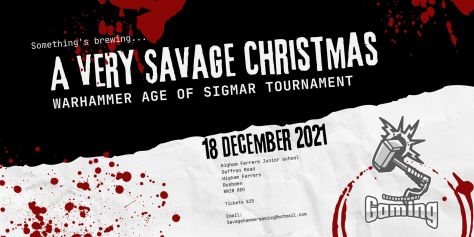
Something’s brewing…… and it happens to be a Christmas Age of Sigmar tournament here in sunny (!) old Northamptonshire.
This is the first organised tournament for two years that I know of, that is being carried out in my home county. The tournament is being organised by Savage Hammer Gaming in conjunction with Cooper Gaming Ltd.
It takes place on 18th December at Higham Ferrers Junior School Hall and to take part you’ll need to bring a fully painted 2,000 point army using the points from the Generals Handbook 2021, Dice (why not buy some Savage Hammer Gaming dice?), a tape measure, objective markers and two copies of your army list.
There are a number of prizes on offer over the course of the day as well, with awards going to 1st, 2nd and 3rd place as well as most sporting player and best painted army. They’ll also be a wooden spoon prize!
9.00am
Registration
9.15am
Event Brief
9.30am
Game 1
12.00pm
Break
12.30pm
Game 2
3.00pm
Break
3.15pm
Game 3
6.00pm
Awards Presentation
6.30pm
Event Close
Timings for the Day
This is the first of many tournaments that Savage Hammer Gaming are hoping to run and their 40k tournament in February next year has already sold out! If you want to buy a ticket, then please follow click here.
I will cover the highs and the lows of the tournament once it has taken place and post the results and photos here on the website!
Blood Red Skies is the new World War II mass air combat game from Warlord Games, written by renowned game developer Andy Chambers.
Packed with everything you need to play this fast paced air combat game, the Blood Red Skies starter set does what it says on the tin. Plus once started you’ll have the extra rules to introduce the play cards that really bring your fighter aircraft to life, allowing you to fly them just as they would have been by the Aces of WW2!
Description from Warlord Games
First of all, right off the bat, this isn’t a simulation game. If simulation of World War 2 dogfights is what you’re looking for then this isn’t the game for you.
Blood Red Skies: Battle of Britain
However that being said, there has been a lot of work that has gone into the rules to give them an authentic ‘feel’ of the period.
The Blood Red Skies: Battle of Britain starter set contains everything you will need to carry out air battles over the British Isles in World War 2. With six Spitfires, six Messerschmitt BF-109s and a number of scenarios through which the players can jump straight in.
The minis unpainted
The games core mechanic revolves around aircraft being Advantaged, Neutral and Disadvantaged. Disadvantaged aircraft cannot shoot aircraft that are Advantaged or Neutral and Neutral aircraft cannot shoot Advantaged aircraft. However, you can choose to make your aircraft disadvantaged to gain manoeuvrability and enabling you to try and get on the tale of enemy aircraft.
Scoring is done by using boom chits, where any shots that hit the enemy cause a chit regardless of whether it causes damage. Once a player has more chits against them than they have aircraft then their squadron are forced to break contact with the enemy and head for home. This can mean that games are over without a single aircraft being shot down, which is true to the real life dogfights that would be carried our in the skies during World War 2.
Painted Luftwaffe Aircraft
Gameplay is quick with a loop of Shoot-Move-Action that is enhanced by the use of the action deck, with extra abilities and events. These cards can be selected based on the planes in use and the period of the war the combat is taking place.
Downsides of the game are that the pilot discs are easy to damage when inserting or removing them from the plane bases. Measuring can also be tricky with arcs being difficult to set on the circular bases.
That said, this game is fantastic and is ideal for a quick pick up and play game during a lunch break or a spare 30 minutes with friends in between other games.