Category Archives: Historics

Kreigsspiel Battle Report – Battle of Ravine-à-Couleuvres

Historically the Battle of Ravine-à-Couleuvres also known as the Battle of Snake Gully, was a major battle of the Haitian Revolution on 23 February 1802.

A French division under General Donatien de Rochambeau was advancing down a ravine (the Ravine-à-Couleuvres), towards Lacroix, Artibonite, where they attacked the army of Toussaint Louverture. Louverture’s forces consisted of 1,500 elite grenadiers, 1,000 grenadiers in different Demi-brigades, 400 dragoons. Louverture’s forces resisted the attack strongly, but had to retreat across the Petite-Rivière after suffering 800 deaths.

Prior to the battle on 22 February 1802, the French occupied the heights of Morne Barade and were attacked by rebel troops; the battle raged throughout the night and the French forces successfully resisted the attack. The following morning, the Haitian forces advanced out of the Ravine-à-Couleuvres as the French were travelling down it towards Lacroix, while Louverture rallied his cavalry. According to Bell, the losses of Louverture’s army were minor.

The Gameplan

This would be my first game in Kreigsspiel and as such I was learning the ropes from the other players when I was able to communicate with them during the battle. That said it was an awful lot of fun and made me think of Kreigsspiel as more of an RPG wargame rather than the table top precisely measured game you imagine it to be.

This game took place with six players on each side, an overall General and then five Generals of Brigades. I was placed on the French side and in command of the third Brigade.

Unfortunately there were no accurate maps of the area available and so the game was to be played on a similar landscape using the Fredericksburg map from the Amercian Civil War.

The Battlefield

Our mission was simple, we were to enter from the north and take and hold the river side city as quickly as possible, while the rebels were out to stop us.

Our General issued his orders to us, which involved the Cavalry Brigade scouting the main route down to the city and assessing where the rebel locations were while avoiding combat if possible. My brigade was to follow the route taken by the cavalry as quickly as possible to try and take and hold the southern most part of the city ensuring that we held those bridges. The remaining brigades were to move to the northern part of the city to secure the crossing points there.

My initial orders showing the target positions of where I wanted my battalions to be placed once they reached the city.
07:45 On our route down our wagons get stuck in mud and I’m forced to lose time ordering our lead battalion to assist in freeing the wagons. At this point I wasn’t quite aware that orders had already not been understood, as my wagons were leading the column towards the enemy!
At 08:00 I assumed that the lead four battalions were well ahead of us this point after our delay freeing the wagons from the mud. So I sent orders to them via ADC advising them where to position themselves in the city until our arrival.
At 08:15 it became clear that all of my battalions were in fact towards the rear of the column.
At 8:30 contact is made with the enemy by the Cavalry screen in front of us.
08:30 Some frantic ordering in response to the firefight ahead sees me attempting to move my battalions in front of my wagons finally and deploying skirmishers while our General rides on ahead bravely to see whats going on
Brigade makes contact with the enemy and moves to support our cavalry.
08:45 As we were no co-located with the Cavalry commander we were able to get his report on the situation straight from the horses mouth (pun intended). I order my remaining battalions that have not yet arrived to push into the fields on the right as the nearest bridge to he city was just a couple of fields away to our right. We had the intention to punch through the enemy and try and make it to those bridges.
09:00 The initial combats appear to be going in our favour although the cavalry on the right are already starting to suffer casualties and the arrival of enemy cannon does not help our situation. I order my remaining three battalions to move up on the right flank to try and relieve the wounded cavalry elements.
09:15 My infantry start to gain the upper hand in the combat but the artillery is a worry.
I give orders for my troop movements with the intention to try and push my very slight advantage, I also send a message to the other Brigades to inform them of our plight.
09:30 The fighting intensifies, but my men start to run out of ammunition and are taking casualties at an alarming rate. I order my troops to retreat back along the road until we’re beyond the range of the enemy artillery.
10:00 My men begin to pull back
10:15 and my men begin to recuperate and rearm, while are Cavalry push back into the fields on the right.
10:30 and our Cavalry route the rebel cavalry and pursue their Generals. Only to be halted by the dreaded artillery. Prompted by this I order my battalions to take the enemy guns as quickly as possible, hoping to remove them from play or possibly even capture them for our own use.

And with that the game was over. While myself and my fellow gamer who was in charge of the Cavalry had managed to smash aside the Haitians, capture their guns and even wounded their commanders (I think)in our little corner of the battlefield. It just wasn’t enough with the 1st and 2nd French Brigades getting badly mauled to the north there was no hope of our little force crossing the river and securing the town.

A victory for the Haitians but a costly victory.

Summary

This was a fantastic introduction to Krieggspiel and I thoroughly enjoyed myself throughout.

It wasn’t anything like I expected, and in the end felt more like a Role-playing game where you’re in charge of a specific General. I highly recommend anyone to take a look at this game and perhaps join the International Krieggspiel Society and dip your own toes in!

Unboxing – French Starter Army for Black Powder: Epic Waterloo

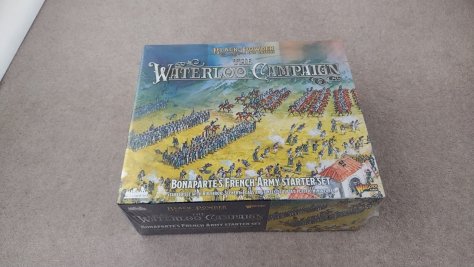
Warlord Games have released their Epic Waterloo miniatures and game system this weekend just gone. I was lucky enough to pick my French Starter Set from SCN Hobby World yesterday and I was eager to take a peek and see what was inside.

It’s one of the largest starter boxes I’ve seen, and one of the heaviest! I picked mine up at 20% off for £72 through Sarah at SCN Hobby World.

Lifting the Lid

Theres a tonne of sprues inside. Ten infantry, three heavy cavalry and three light cavalry. Along with the meaty full colour rulebook, a scenery piece, painting guide and flags. I

It was all very nicely packages tightly inside. Warlord must have learnt their lesson form the ACW version Starter Set here, as a common complaint was that everything was a bit loose inside that box and often some of the contents would arrive damaged.

“Do you have a flag….?” – Eddie Izzard

They have coloured the plastic of both starter sets, (blue for french and Red for British) so if you’re eager and know someone with the other set you can play straight away without the need for painting.

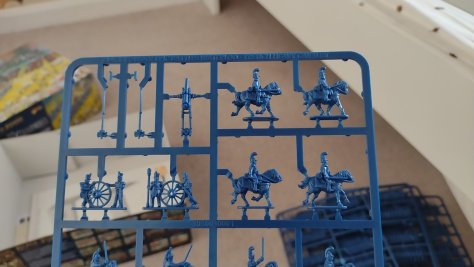
Sprue 1 Light Cavalry

Hussar!

There enough here for 11 bases of Light Cavalry, as well as 3 artillery. Made up of 4 Lancer bases (one spare model), 3 Hussar bases (3 spare models) and 4 Chasseur bases (1 spare model). None of these models are command models but the addition of two Imperial Eagles on each sprue allows you to convert some in to standards. You can also use the spare models for ADC’s or for diorama pieces on your Brigade Commander stands.

Geek Point 1: The standards were made optional as none of the French Cavalry had their standards on the Waterloo campaign.

Sprue 2 Heavy Cavalry

These are the other 10 bases of Cavalry, but these make heavier versions of the Cavalry regiments. Here you’ll have 4 bases of Cuirassiers, 3 bases of Carabiniers and 3 bases of Dragoons. Again, you have the inclusion of an artillery piece on each sprue and two french eagles. There were a lot more Cuirassiers and Dragoons at Waterloo than Carabiniers but I can understand why Warlord have included one of each type on the sprue.

Sprue 3 Infantry

There’s loads of infantry… all told just over 800 men. The detail on the sprues is incredible given their size, and time has been taken to differentiate the flank companies of Grenadiers and Voltigeurs from the centre companies.

This sprue is packed. You’ve eight stands of infantry and enough skirmishing Voltigeurs for another stand, as well as some foot artillery and a command figure.

Bases

Bases… lots of them!

Of course, none of these would play well without the basic addition of bases… just look at that pile! It’s huge.

Dice

And some dice… as if wargamers don’t have enough to build their own fort! Still a good inclusion for a starter set.

Declan’s picture of the dice included

Decoster’s House – Building

Decoster’s House

Warlord games have teamed up with Sarissa Precision to bring some scenery with the boxset which also comes with its own painting guide and stencil.

Flags & Painting Guide

A great addition is a full colour sheet of French flags. This will really add to the colour and make the regiments individual on the tabletop. Well done to Warlord games for this inclusion.

Rulesbook

The full rules book for the Waterloo Campaign in Epic Battles. This appears to be a full rulebook at 260 pages. It’s in glorious full colour as well and means you don’t need a separate copy of any of the existing Black Powder rule books.

Summary

This is a great box, and real value for money. It should draw many GW fans looking to get into Napoleonics. Declan and I are just two of them.

Warlord Games Epic Waterloo – Painting Guides

In my excitement for receiving my Epic Waterloo French Starter set from Warlord Games, I’ve been perusing the internet looking for painting guides. The below are a collection of the best videos I have found. All of these videos have been published on YouTube by Miniature Realms, Miniature Wargaming Warriors

British Line Infantry


Royal Horse Artillery

British Riflemen

French Voltigeurs

French Line Infantry

Epic Battles Carabinier Test Model

I’ll often paint a single test model before batch painting the rest. It lets me take my time on making sure I’m selecting the right colours.

In the case of Napoleonic miniatures I find this is also useful as I will refer to images on my phone about the uniform of the unit I’m painting. Then, once the model is done, I can just keep it in view while I paint the remainder. This prevents me having to keep turning the old phone on and off while I paint.

So here’s the model, this is a phone picture so apologies.

And the colours I used are:

  • Teclis Blue for all blue parts
  • Pallid Wych Flesh for the white
  • Mephiston Red for red
  • Runelord Brass for the gold
  • Stormhost silver for any metal
  • Rhinkx Hide for the horse

Simples!

What is Bolt Action?

BOARD GAME GEEK SUMMARY

It has been given a rating of 7.8 on BoardGameGeek from 550+ ratings.

Written by veteran game designers Alessio Cavatore and Rick Priestley, Bolt Action provides all the rules needed to bring the great battles of World War II to your tabletop. Using miniature soldiers, tanks and terrain, you can fight battles in the shattered towns of occupied France, the barren deserts of North Africa, and even the sweltering jungles of the Pacific.

Players get to decide which of the major or minor World War II powers they would like to represent, and then construct their armies from the lists provided. Army options are almost limitless, allowing you to build the kind of army that most appeals to your style of play. The choice is yours.

The original… now changed slightly in Warmaster Revolution

On Point HQ has produced a series of excellent videos explaining Bolt Action. I recommend checking our his other videos as well!

1. Building a Bolt Action Army

2. Unit Quality and Issuing Orders

3. Combat

4. Pinning and Morale Tests

5. HQ Units and Snap to Action

6. Transports and Tanks

7. Ambush

8. Troop and Vehicle Movement

9. Medics and Snipers

10. How HE Shots Work

11. Artillery Movement and Orders

12. The Turn Sequence

If you’re interested in getting into Bolt Action, I can’t suggest you start anywhere else but these excellent collection of videos.

Peter

Napoleonic Wargame Free to Download

I’ve added a page to the website called Wargame Rules. In there you will find any rules for scenarios or wargames that I write. At the moment its pretty empty apart from one item which is Clausewitz.

Clausewitz is the Napoleonic wargame I’ve been working on for a number of years now. This is still very much a work in progress but I’m pleased to say it’s at a stage now where I feel comfortable releasing it for public consumption.

What is Clausewitz?

Clausewitz is a Corp level game designed primarily for 6mm Napoleonic warfare. I always wanted a Napoleonic game which focused on the whole battle but where what the individual battalions actions were still important to the outcome. Therefore in Clausewitz although the basic unit is the Brigade, those brigades are made up of individual elements called Battalions or Squadrons. Think of this like individual models inside a squad in a game like 40k or AoS.

The key features of Clausewitz include:

  • A departure from the traditional IgoUgo turn sequence and instead relies upon chips drawn from a bag to represent a Generals actions in the turn (with each turn representing 10 minutes of battle).
  • The game is driven by your Generals, they must position themselves and activate the right units at the right time in order to win the day.
  • Objectives – There are six objectives and units can only claim an objective (and therefore score points) if a General has ordered them to do so.
  • Mini-Game – there is an optional fun mini pre-game to the main event in which your light troops determine the deployment zone in the upcoming battle.
  • Formations matter! Brigade formations and individual unit formations are presented in an intuitive fashion. The players must ensure that their units are in the right formations for the task at hand!

Alternatively there are two mods on Tabletop Simulator just for Clausewitz, the first being the test bed which is used to test the various rules as they are implemented or adjusted and the second being the Battle of Elchingen 1805, where the Austrians attempt to defend against the French advance.

Test Bed

Battle of Elchingen

So why not give it a go and send your feedback to help me improve it?

Black Powder Epic Waterloo British Cavalry

So my issues of Wargames Illustrated arrived this week with their accompanying sprues.

I managed to get hold of three copies of the British Heavy Cavalry sprue.

The Sprue in all its glory.

I’ve started by painting the Scots Grey’s and first off these models are really easy to paint straight on the sprue. You just need to clip away any armatures of the sprue that are connected to the horse or riders directly.

I may have gone a little too detailed considering their size but this is only because I’ve enjoyed painting them so much.

I can’t wait to see the unit finished and on its base. I’m also looking forward to painting the cannon and seeing what that looks like. Once I’ve a few units done I’ll post again.

My Introduction to Kriegsspiel as a Player

After my many years as a wargamer (25+ years) I’ve played quite a number of different games during that time, but one that I’ve never played (despite hearing about) is Kreigsspiel the original wargame written in the 1800’s by George Leopold von Reisswitz.

Kreigsspiel is a game of warfare that attempts to realistically replicate what would happen on a battlefield during the 1800’s. It requires a map, some blocks to represent the different units involved and three players.

The Battle of Waterloo played in Kreigsspiel

Why three players?

When I say three players, what it actually involves is two players and an umpire. But it’s best to think of the umpire as a Games/Dungeon Master.

Each player is only aware of what their own units are doing on the table top and exactly where they’re positioned, and the enemy movements and units only become apparent once they move into visual range of your own. This is where the umpire comes in.

Each player communicates with the umpire how they wish to deploy their units and what movements and actions they would like those units to take. This gives the players a true fog of war setting.

It sounds complex right?

Yes it does! But actually it’s really not. Why? Because the only person who needs to know the rules is the umpire. The players just have to communicate with the umpire what orders they would like their units to follow. This can be communicated either in an RPG format or a simple “I would like these units to entrench themselves on top of the hill overlooking the town

The umpire then moves both players units according to their wishes and communicates back to the players if any contact has been made with the enemy.

When contact has been made the players then decide how they want their units to act, i.e. “The units will form line and wait for the enemy to attack before firing.”

The umpire then rolls the dice and decides the outcomes for that turn (which replicate a few minutes of real world battle at a time).

That Sounds like it takes Ages!

Actually no, a small game of Kriegsspiel can played out in a few hours. Or you can even play it on a play by post basis with a number of friends negating the need for vast spaces to be used like a conventional table top wargame.

Why have I not played this before?

When I read about the rules and the requirement for three players I immediately thought it would be too difficult to get a game together. Bot was I wrong!

The International Kreigsspiel Society which I have recently had the honour of discovering, have a Discord channel where you can join introduce yourself and just jump straight in with your first game!

I’ve recently started two play by post games, one being a small battle during the Haitian Revolution and another being the Battle of Chancellorsville in 1863. In the first I’m in command of a small Brigade of infantry (7 battalions) with the game having 5 players a side, while in the second I have an entire Division under my command and roughly 17 players per side.

A simple game of Kreigsspiel

Is it just for Wars in the 1800’s?

Absolutely not, the Society is currently developing additional rules for World War 2 and Ancients to name but two.

Interested?

If this sounds like your cup of tea, then why not slide into the Discord server and take a look around, perhaps try a small game with the friendly guys who run the many games each week that takes place.

INTERNATIONAL KREIGSSPIEL SOCIETY DISCORD SERVER

Writing a Tabletop Wargame – Part 1

I’ve always enjoyed creating my own rules and scenarios for the games I play, and last year I jumped into writing my own ruleset for Napoleonic Wargaming called ‘Clausewitz’.

But I thought it may be fun to create a ruleset with the community which could then be hosted here on the site for free.

So what should it be? A historical game? Sci-Fi, Fantasy? Should it be Grand Tactical, skirmish level or something in between?

What about measurements? Should they be in inches, centimetres, base widths or something completely different?

As you can see there are a lot of points to consider before getting into the nitty gritty of it all. So let’s tackle the first question.

Genre

What about the genre? What should it be. Well that’s up to you all. Why not vote in the poll below that I’ll keep open until the next article and you can decide here what we work on. Of course there’s always an argument to make the game genre agnostic as well, meaning the ruleset can be used for anything…