I recently purchased and painted a ruined Chapel from Etsy for use in Old World and Silver Bayonet.
It doesn’t come with lights….
It comes in three pieces with the two floor separate and the roof making the third part.
Painting it was fairly simple as I chose to undercoat the model black and then dry brush mechanicus standard grey on the stone with a further dry brush highlight of coral white and mechanicus standard grey mixed 1:4.
The roof was painted in Word Bearers Red and then drybrushed with Mephiston Red and then a lighter drybrush of Wild Rider Red.
The final part was the wood. Which I painted with baneblade. The whole model was then shaded with Agrax Earthshade.
Finally, using Geek Gaming basing materials was the simple finish to the model.
Painting the whole model took around 2 hours start to finish.
The wolves close in on the French, who take shelter in a ruined chapel.
Black Powder is a game system produced by Warlord Games and written by Rick Priestley and Jervis Johnson. As the introduction to the rules says:
Black Powder is a game for militarily inclined gentlemen with straight backs, bristling beards and rheumy eyes that have seen a thing or two. If tales of battle and glory in days-gone-by stir nothing in your breast, if the roar of cannon does not quicken the pulse and set a fire in the belly, then stop reading forthwith. Ours is not an adventure to be embarked upon by the faint hearted. Put down this book and be glad that you have spared yourself the discomforting spectacle of grown men attempting to relive the great conflicts of history with armies of toy soldiers.
So heft your muskets and prepare for battle. The library or billiard room will serve as our battlefield, or else some similarly spacious and secluded refuge. Ensure that children are put to bed and lie safely beyond earshot. Secure the doors against the intrusion of womenfolk as yet unfamiliar with the conventions of war. Ready your armies for the long march to glory.
And finally, let us remember that the ideal accompaniment to the journey may be found in good brandy, fine cigars, and the companionship of like-minded enthusiasts.
Black Powder 2nd Edition (2019)
Black Powder covers the Horse and Musket period from 1701 (War of the Spanish Succession) to 1898 (Second Sudan War). Most commonly you’ll find players use the system to refight engagements from the Napoleonic Wars or the American Civil War.
I personally believe that Horse & Musket games come in one of two formats. Either simulation, where the rules will try and accurately represent a battle of that period in minutiae. Or in a more ‘Arcade’ format, where an approximation of the overall battle is given.
The game itself can be played at most miniature scales, with the smaller scales adding to the big battle feel of the game you’re playing.
Black Powder doesn’t have miniature removal and instead uses markers to show the status of units. Units are usually made up of 4 stands and these will be arranged to shoe what formation a unit is in. Units are usually at a battalion/squadron level, but you can use Units to represent larger formations such as Brigades.
So if this time period interests you and you have a specific war in mind, Black Powder may be the system for you.
To give you more of a taster, we’ve put together a number of articles covering the basics of a turn in Black Powder which, should give you a feel of how the game plays.
I have bought the new Epic Battles: Waterloo by Warlord Games and I’m slowly making my way through the painting much like Declan (when I’m not painting those pesky Kruleboyz). However, one thing I’ve noticed (as I’m sure many others have as well), is that the models are epic in scale but the basing and the rules are standard Black Powder. What I mean by this is that a standard unit in Epic:Waterloo is the same as a standard unit in regular Black Powder.
This got me thinking to how you could have truly cinematic and epic battles in Black Powder by converting the inches to centimetres (like many others have done).
By doing this, you can play a regular game of black Powder on a much smaller play area – 2.4 feet by 1.6 feet rather then 6′ x 4′. But also, it gives you the option of playing much, much larger games on a regular table.
The only issue is the basing and miniatures. if you take a standard unit in Black Powder with a frontage of 240mm and divide this so it suits the cm measurements rather than inches (i.e. dividing 240mm by 2.5) you’ll get a standard unit frontage of 96mm (let’s call it 10cm). If we use increments of 20mm then the basing could look something like this:
The great thing about his, is that if you use Baccus Napoleonic 6mm infantry you can get two large bases completed for just £8.00!
But what about different formations. Well these could either be represented by a dice in one of the dice holders on the base (i.e. 3, for line, 4 for square etc) or you could just model some other bases as Square and attack column etc. I’m inclined by the later personally.
The other dice holder can also be used to measure the units stamina. For Dice holders I’m always inclined to use Pendraken.
But I’d like to know the opinions of those experienced in Black Powder and what they think!
This post is partly a reference for myself as to which colours to use (Citadel or Vallejo) when painting my Epic Battles Napoleonic French. I’ve listed colours that could be used from both systems.
All of the paints listed can be purchased from ElementGames. Why not use my referral code and get double the crystals when you purchase anything? XBJ9837
Line Infantry
An overall base coat should be applied with London Grey or Mechanicus Standard Grey.
BASE COAT
Area
Vallejo
Citadel
Jackets
Dark Prussian Blue
Kantor Blue
Belts/Muskets/Slings & Lapels
Light Grey
Grey Seer
Trousers
Any of Offwhite, London Grey or Beige
Pallid Wych Flesh, Mechanicus Standard Grey or Karak Stone
Shako & Boots
Black
Abaddon Black
Skin
Basic Skin Tone
Cadian Flesh
Collars, Cuffs & Lapel Piping
Dark Vermillion
Mephiston Red
(Voltiguers) Plumes & Epaulettes
Black Green
Caliban Green
(Voltigeurs) Collar, Epaulette edging, Pompom, Tip of Plume
Yellow Ochre
Yriel Yellow
(Grenadiers) Plumes, Epaulettes and Shako Lace
Dark Vermillion
Mephiston Red
Backpacks & Musket Wood
Flat Brown
Mournfang Brown
Musket Barrel, Bayonet & Canteen
Oily Steel
Leadbelcher
Shako Plates, Sword Hilts, Chin Scales & Buttons
Old Gold
Retributor Gold
WASH
Area
Vallejo
Citadel
Grey Trousers, Shako Covers & Steel
Dark Tone
Nuln Oil
Beige Trousers & Shako Covers
Strong Tone
Agrax Earthshade
White Trousers
Dilute Light Grey
Dilute Grey Seer
Skin & Gold
Flesh Wash
Reikland Fleshshade
HIGHLIGHT
Area
Vallejo
Citadel
White
Offwhite
Pallid Wych Flesh
Yellow
Flat Yellow
Dorn Yellow
Green
Intermediate Green
Warpstone Glow
Black
Black Grey
Dark Reaper
Bayonets
Plate Mail
Stormhost Silver
Light Infantry in Greatcoats
An overall base coat should be applied with London Grey or Mechanicus Standard Grey.
BASECOAT
Area
Vallejo
Citadel
Greatcoats
London Grey, Beige or Light Brown
Mechanicus Standard Grey, Karak Stone or Balor Brown
Trousers & inside Open Jackets
Dark Prussian Blue
Kantor Blue
Piping, Belts & Straps
Light Grey
Grey Seer
Shako & Boots
Black
Abaddon Black
Skin
Basic Skin Tone
Cadian Flesh
(Carabinier) Straps, Plumes, Epaulettes and Shako Lace
Dark Vermillion
Mephiston Red
(Voltigeurs) Epaulettes & Plume
Black Green
Caliban Green
(Voltigeurs) Collar, Edge of Epaulettes, Shako Lace & Tip of Plume
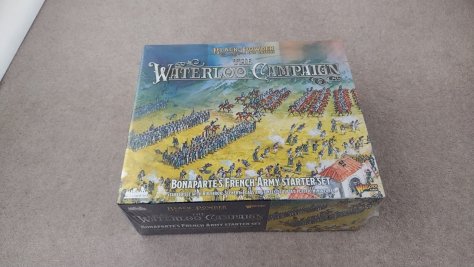
Warlord Games have released their Epic Waterloo miniatures and game system this weekend just gone. I was lucky enough to pick my French Starter Set from SCN Hobby World yesterday and I was eager to take a peek and see what was inside.
It’s one of the largest starter boxes I’ve seen, and one of the heaviest! I picked mine up at 20% off for £72 through Sarah at SCN Hobby World.
Lifting the Lid
Theres a tonne of sprues inside. Ten infantry, three heavy cavalry and three light cavalry. Along with the meaty full colour rulebook, a scenery piece, painting guide and flags. I
It was all very nicely packages tightly inside. Warlord must have learnt their lesson form the ACW version Starter Set here, as a common complaint was that everything was a bit loose inside that box and often some of the contents would arrive damaged.
“Do you have a flag….?” – Eddie Izzard
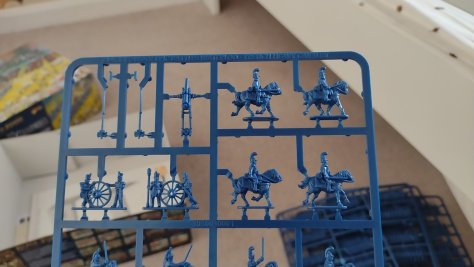
They have coloured the plastic of both starter sets, (blue for french and Red for British) so if you’re eager and know someone with the other set you can play straight away without the need for painting.
Sprue 1– Light Cavalry
Hussar!
There enough here for 11 bases of Light Cavalry, as well as 3 artillery. Made up of 4 Lancer bases (one spare model), 3 Hussar bases (3 spare models) and 4 Chasseur bases (1 spare model). None of these models are command models but the addition of two Imperial Eagles on each sprue allows you to convert some in to standards. You can also use the spare models for ADC’s or for diorama pieces on your Brigade Commander stands.
Geek Point 1: The standards were made optional as none of the French Cavalry had their standards on the Waterloo campaign.
Sprue 2– Heavy Cavalry
These are the other 10 bases of Cavalry, but these make heavier versions of the Cavalry regiments. Here you’ll have 4 bases of Cuirassiers, 3 bases of Carabiniers and 3 bases of Dragoons. Again, you have the inclusion of an artillery piece on each sprue and two french eagles. There were a lot more Cuirassiers and Dragoons at Waterloo than Carabiniers but I can understand why Warlord have included one of each type on the sprue.
Sprue 3– Infantry
There’s loads of infantry… all told just over 800 men. The detail on the sprues is incredible given their size, and time has been taken to differentiate the flank companies of Grenadiers and Voltigeurs from the centre companies.
This sprue is packed. You’ve eight stands of infantry and enough skirmishing Voltigeurs for another stand, as well as some foot artillery and a command figure.
Bases
Bases… lots of them!
Of course, none of these would play well without the basic addition of bases… just look at that pile! It’s huge.
Dice
And some dice… as if wargamers don’t have enough to build their own fort! Still a good inclusion for a starter set.
Declan’s picture of the dice included
Decoster’s House – Building
Decoster’s House
Warlord games have teamed up with Sarissa Precision to bring some scenery with the boxset which also comes with its own painting guide and stencil.
Flags & Painting Guide
A great addition is a full colour sheet of French flags. This will really add to the colour and make the regiments individual on the tabletop. Well done to Warlord games for this inclusion.
Rulesbook
The full rules book for the Waterloo Campaign in Epic Battles. This appears to be a full rulebook at 260 pages. It’s in glorious full colour as well and means you don’t need a separate copy of any of the existing Black Powder rule books.
Summary
This is a great box, and real value for money. It should draw many GW fans looking to get into Napoleonics. Declan and I are just two of them.
In my excitement for receiving my Epic Waterloo French Starter set from Warlord Games, I’ve been perusing the internet looking for painting guides. The below are a collection of the best videos I have found. All of these videos have been published on YouTube by Miniature Realms, Miniature Wargaming Warriors
I’ll often paint a single test model before batch painting the rest. It lets me take my time on making sure I’m selecting the right colours.
In the case of Napoleonic miniatures I find this is also useful as I will refer to images on my phone about the uniform of the unit I’m painting. Then, once the model is done, I can just keep it in view while I paint the remainder. This prevents me having to keep turning the old phone on and off while I paint.
So here’s the model, this is a phone picture so apologies.
So my issues of Wargames Illustrated arrived this week with their accompanying sprues.
I managed to get hold of three copies of the British Heavy Cavalry sprue.
The Sprue in all its glory.
I’ve started by painting the Scots Grey’s and first off these models are really easy to paint straight on the sprue. You just need to clip away any armatures of the sprue that are connected to the horse or riders directly.
I may have gone a little too detailed considering their size but this is only because I’ve enjoyed painting them so much.
I can’t wait to see the unit finished and on its base. I’m also looking forward to painting the cannon and seeing what that looks like. Once I’ve a few units done I’ll post again.