Tag Archives: 6mm Grand Tactical

Writing a Sci-fi Tabletop Wargame – Part 10

As with everything I would like this to be community driven, so if you see any typo’s or think paragraphs need rephrasing or moving then please let me know in the form at the end of this article.

Last Weeks Poll Results for Orders

Here are the results from last weeks polls.

Based on these results, the following section will be added to our living rules:

ORDER GENERATION

At the start of a turn each player will roll 2D6 and add the number of Generals they have on the table to that roll; this is their ORDER POOL.

WHO GOES FIRST?

Who gets to use an order first in the turn is determined by bidding. Once the ORDER POOL has been generated, each player should say how many orders they wish to use to bid for the FIRST ACTIVATION of that turn. Any orders that have been used to bid for the FIRST ACTIVATION are lost from the ORDER POOL regardless of whether the bid was successful or not.

For example, Player A rolls 9 for their ORDER POOL, and decides to use 4 orders to bid for the FIRST ACTIVATION of the turn. If they bid more than the opposing player, they can activate a unit first that turn. If they bid less than their opponent then they will have the SECOND ACTIVATION that turn. Regardless of whether the player wins the bid or not, they lose the number of orders that they used to try and claim the FIRST ACTIVATION that turn. In the case above Player A will have 5 orders remaining in their ORDER POOL which they can use to attempt to order their units with in the coming turn.

ORDERS

When an order is being issued, the player must first determine the score needed in order for the target unit to activate. To do so add the COMMAND RATING of the unit to that of the nearest friendly General on the table. This combined rating will then be used as a score which the player must equal or beat on a roll of 2D6 in order for the order to be effective. If the player does not achieve the score needed then an order is lost from their ORDER POOL and the next player then attempts an activation.

For Example, Player A wants to activate an elite unit on their left flank that has the possibility of claiming an objective. The units COMMAND RATING is 2, and the nearest General’s COMMAND RATING is 4, giving a combined total of 6. Player A rolls a 7 on 2D6 and so is able to issue an order to that unit.

THIS WEEKS POLLS

There are two further poll it has been suggested to me to add in regards to Orders.

Firstly, if a unit has been successfully given an order, does it carry out any actions the player wishes OR should it be a specific order such as move or shoot.

Secondly, if a unit has been issued an order can you then issue another order to the same unit? If so, should there be a limit on the number of orders any one unit can receive?

Next week we’ll begin to look at the stats of a unit.

–Peter

Suggestions?

Do you have any rules suggestions, or a topic you would like us to focus on next. Or perhaps you would like us to reword something in the main document. Anything you want, let us know below.

← Back

Thank you for your response. ✨

Writing a Sci-fi Tabletop Wargame – Part 9

Last Week’s Polls

The results of last week’s polls are as follows:

In replacement of listing every post on this project so far, I’ve started a written document that should eventually evolve into the ruleset for the game.

As with everything I would like this to be community driven, so if you see any typo’s or think paragraphs need rephrasing or moving then please let me know in the form at the end of this article.

Orders

My aim is to tackle each stage of the game as you would expect it to occur. So that being said, at this stage my assumption would be for the order phase to come first. But what do we need to look at? We already know that each player will roll 2D6 for their number of orders which will then be modified by their Generals on the table. But how should these be modified?

For example, should order effectiveness be based on a rating of that General? Should it be easier to order some units over others?

Should orders be also used to boost things such as combat effectiveness in a fight? For example, perhaps a friendly unit wants to fire upon an enemy unit. The General has already used one order for this to happen, but perhaps he could use an additional order to add +1 to the dice result?

Order Generation Modification

There’s a few options in regards to the modification on generating orders.

Should the roll be 2D6 plus one for each General in the army?

Should the modification be +1 for a Brigade General, +2 for A Divisional General and +3 for a Corp General?

Should personality come into affect instead? Perhaps having a 2D6 roll but then certain special rules may affect this, such as a General being hot-headed (-1 to the roll) or inspired (+1 to the roll).

Or perhaps some other option?

Issuing Orders

The next matter is all about how the player issues orders to their units.

Order Distances

Should distances between the Generals and the unit it wishes to order come into affect? Or do we assume in a futuristic era that order distance does not matter?

Understanding Orders

Should each General have a command value which the player needs to roll against to see if the order is successful? (Warmaster Revolution Style) e.g. A general has a command value of 2, if the player rolls equal to or higher than this on a single die then it is successful. Should this be on 1 die or two dice?

Perhaps Generals and Units have command values which the combined total has to be equalled or beaten on 2D6? (Clausewitz Style) e.g. A good General has a rating of 2, and a regular unit a rating of 4. The General will need to roll 6 or more on 2D6 to issue an order to that unit.

Should the roll for whether a unit understands an order be a simple amount of 3+ no matter the General or its target?

Should orders be understood automatically thus negating the need for any rolls?

Or perhaps some other option I’ve yet to consider?

Failing Orders

Finally for this week we going to cover what happens when a General fails issuing an order. Note that this vote will be made redundant should the option “Orders are automatically understood” is the winner in the above poll. Should there be a penalty for failing to issue an order?

Perhaps that particular General is unable to issue any other orders if it fails to order a unit?

Perhaps no orders are able to be issued by that side should an order roll be failed?

Well that’s it this week. It’s been a bit of a long one hasn’t it? But the orders section should almost be completed once the votes are in. See you next week!

–Peter

Suggestions?

← Back

Thank you for your response. ✨

Do you have any rules suggestions, or a topic you would like us to focus on next. Or perhaps you would like us to reword something in the main document. Anything you want, let us know below.

← Back

Thank you for your response. ✨

Writing a Sci-fi table top Wargame – Part 8

The results of last week’s polls are as follows:

In replacement of listing every post on this project so far, I’ve started a written document that should eventually evolve into the ruleset for the game.

As with everything I would like this to be community driven, so if you see any typo’s or think paragraphs need rephrasing or moving then please let me know below. This is completely anonymous.

← Back

Thank you for your response. ✨

Objectives

Every battle has a purpose. There are many ways to decide on objectives for a game. There’s the pre determined locations that games like Age Of Sigmar or 40k uses that ensured there distribution is fair and even. It there is the method where players take it in turn to place them randomly. Or there’s the narrative version where each army needs to perform a certain task or survive for a certain number of rounds.

However, I have another proposal. What about narrative objectives that make sense? For example, the invaders primary object in a battle may be to take and hold an ammunition dump. While also having a number of secondary objectives such as cutting a fuel supply line or destroying a communication centre. Plus, as our game will encompass all aspects of warfare such as space, land and aerial combat these objectives can be tied together in a campaign.

Deployment

This links me nicely to my next topic which is deployment. There are a number of options here.

One I used in Clausewitz was for light infantry units to count as deployment markers which then took part in a mini game to decide the deployment zones before a game. Here’s an example video:

Or alternatively, we have specified table edges with a set distance from the edge.

Or, there is the option to have the defender set up where they feel appropriate given the objectives (this would be more for narrative based objectives), and the attacker would then ‘drop in’ or arrive in on or at certain points of the table that are a certain distance from the enemy.

Lastly, there’s the Argument of Kings option where units arrive on their table edge only after a certain turn. i.e. light units can arrive from turn one, regular infantry turn two, heavy infantry and light tanks turn 3 and so on.

Suggestions?

Do you have any rules suggestions, or a topic you would like us to focus on next. Or perhaps you would like us to reword something in the main document. Anything you want, let us know below.

← Back

Thank you for your response. ✨

Writing a Sci-Fi Tabletop Wargame – Part 6

Our past posts:

So the results of last weeks votes are as follows:

Factions

Now we’ve got most (if not all) of the basic information in place for our game we can start getting our hands dirty with some of the nitty gritty stuff. Firstly, should we have pre-made ready to go factions or should players have options to construct their own units for their own faction? This would make the game miniature agnostic but it would also require players to take the time to build a faction from the ground up, i.e. this is a leader unit it needs this particular weapon, with this armour and these special rules.

Of course we could always have a mixture of both pre-made and create your own. But what do you think?

Turn Order

This is about how the players determine who goes first. There are many options for this, but I’ve narrowed this down to two or three, but bear 🐻 in mind these can also have vary to some extent. For example, while AoS is a UgoIgo system it also implements the turn priority in terms of a dice roll before each turn.

I Go You Go

This is the first and possibly most common option used. Players use a mechanic to determine who goes first and then play is simply alternated between the players until the end of the game.

Draw

Players use coloured dice or chips to represent their individual units on the table e.g. one players units are represented by red dice while the others are blue, when a red dice is drawn the red player chooses a unit to activate. This system will be familiar to those who have played Warlord Games Bolt Action.

Initiative

This could either be an army wide initiative rating or individual initiative ratings for units to decide what order they act in. For example, elite units may have a much higher initiative than conscripts meaning they’ll always act first.

Bidding

One of my personal favourites is using bidding systems to determine who acts first. This can take various forms such as rolling a number of orders each side can take on two or three dice then giving up a number of those orders to try and claim the priority that turn.

So which is your favourite? Perhaps there’s one I’ve not even thought of, I’d that’s the case why not add a comment below?

Writing a Sci-Fi Table-Top Wargame – Part 3

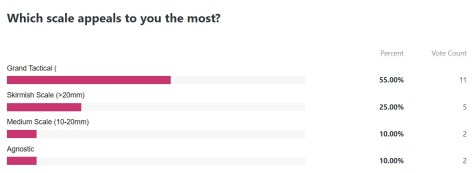
So following on from our voting last week, it would appear that we’re making the game in grand tactical scale (10mm or smaller miniatures) and it will encompass all combat theatres from Land to air and beyond.

I personally find this an exciting proposition as it has the potential to create thematic campaigns and narrative driven stories aplenty!

However before we get into any nitty-gritty rules writing there are still a number of issues we need to clarify.

Measuring

Measuring is a bigger deal than you may think, with our friends over the pond preferring inches and those closer to home often preferring centimetres.

But, they’re no the only options. After all you could also have a hex based map where movement and ranges are set by a number of hexes. Or you could have measurement set by a set ‘constructed’ value such as base widths.

Game Length

The next question is how long do we want a game to take? Under an hour, up to two, an afternoon?

This decision is key as this will dictate how detailed the rules will be in the long term.

Therefore, considering this here are our next two votes!

Remember to check by next week for the results and the next step of our project.